


Embark on a Exhilarating Journey
Discover your True PotentialElevate your PurposeExcel in your AchievementsEnsure your Well BeingImpact the World DeeplyUncover your True Self


What is Intellect Yoga
Vedanta, also known as Upaniṣads, represents the final part of the Vedas. Its magnificence, shining through its many facets, has been beautifully expressed by Shri Krishna via the Bhagavad Gita.

Vedanta encompasses the ethical, existential, metaphysical, philosophical, sociological and behavioral aspects of our scriptures. Personal experience is the most potent measure of the ultimate truth and Sanatana Dharma’s vast body of shastras encourage a scientific approach to accessing all reality.
Intellect Yoga is the consistent practice of learning and implementing the universal, timeless principles and guidance provided in the scriptures. With the purpose of the holistic betterment of our lives and of the universe. Vedanta is a force multiplier for success designed for the most active years of our life. Here and now. We welcome you to Intellect Yoga Institute. Dive in, discover and grow.
25,000+ participants from the previous batches so far!

About Intellect Yoga
Founder & Mentor
“Intellect Yoga Institute is a platform for the research, dissemination and application of Vedanta scriptures for success in the modern context.”
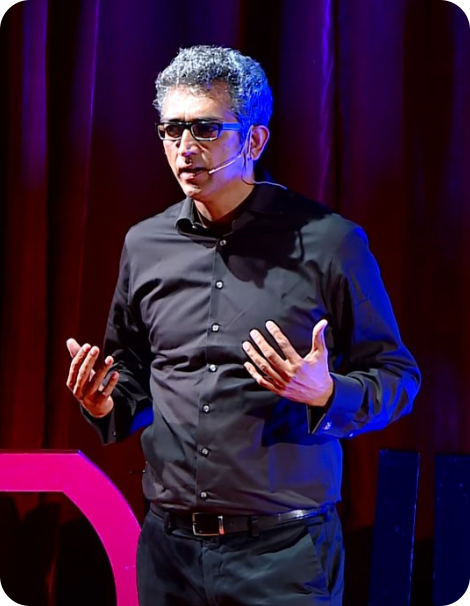
Sampath Kumar Iyengar is a former global CEO and entrepreneur. Currently he is an Advisor and mentor focused on Innovation and Impact initiatives, both private and public.
His career has spanned continents and industries such as Outsourcing, Software, Management consulting and Financial services where he has played technical, consulting, strategy and leadership roles. Most recently he was Partner in a US based hedge fund platform and CEO of Aditya Birla group’s global IT business.
His journey with Vedanta scriptures began in earnest starting 2007 with the Chinmaya Ashram, Princeton, USA. Over the years he has continued to apply and share his learnings. For this treasure, he is grateful to his acharyas and gurus from all sampradayas.
FAQs
View MoreIntelligent people can exhibit poor judgment when thoughts are influenced by Ahaṅkāra (ego), biases, incomplete/lazy understanding, or conclusions based on agitated thought process. Knowledge alone does not guarantee sound judgment. Clear discernment requires critical thinking and the proper use of Buddhi .
Leaders can think clearly under pressure by prioritizing Buddhi (intellect) over Manas (mind) and carefully examining thoughts before acting. By using Buddhi to manage Ahaṅkāra (ego), remaining open to facts, and focusing on solutions rather than reactions, they can maintain clarity and make better decisions in challenging situations.
The Bhagavad Gita helps in decision-making by emphasizing the use of Buddhi (intellect) to guide choices and seek objective truth. It encourages individuals to examine thoughts carefully, manage the influence of Ahaṅkāra and Manas, and choose Śreyas (the right thing) over Preyas (the easy thing). This approach strengthens critical thinking and supports decisions aligned with Dharma .
Yes. Ancient knowledge systems can be applied to modern professional life. Vedanta provides frameworks for critical thinking, leadership development, performance improvement, and decision-making through concepts such as Svabhāva, Svadharma, and Buddhi. These help individuals examine situations more objectively, make ethical choices, and align their actions with a larger purpose.
Emotional bias can be reduced by using Buddhi (intellect) as a filter to observe thoughts and distinguish whether they arise from Manas (mind) or Ahaṅkāra (ego). Vedanta provides a structured approach to examine the source and quality of thoughts before accepting or rejecting them. This helps individuals make decisions based on clarity rather than emotional reaction.
To know the right thing to do, one must follow Dharma , which provides a framework of rules, ethics, and appropriate conduct. This requires understanding one’s Svadharma and choosing Śreyas (the right thing) over Preyas (the easy thing). Buddhi helps evaluate these choices and act with greater clarity.
Outcomes affect our peace of mind when we become attached to results and depend on them for satisfaction. This creates expectations, fear, and agitation, especially because results are probabilistic and not entirely within our control. Karma Yoga teaches that reducing attachment to outcomes helps maintain inner stability.
Critical thinking improves when thoughts are observed rather than immediately accepted.Vedanta encourages individuals to inquire into the source of thoughts and evaluate their quality using Buddhi (intellect) as a filter. Through reflection and self-study (Mananam), thinking becomes more deliberate, objective, and refined.
Intellect Yoga is not a motivational program focused on temporary inspiration, nor a spiritual program centred on belief alone. It is an applied Vedāntic framework and mental model that uses Buddhi (intellect) as the foundation for critical thinking, decision-making, and action through Dharma , Svadharma , Buddhi Yoga , and Karma Yoga.